1861–1865
The Civil War and Emancipation
1861–1865 civil war in the United States between the North and the South over the enslavement of African-Americans
This page discusses the Civil War and the end of legal slavery in the United States.
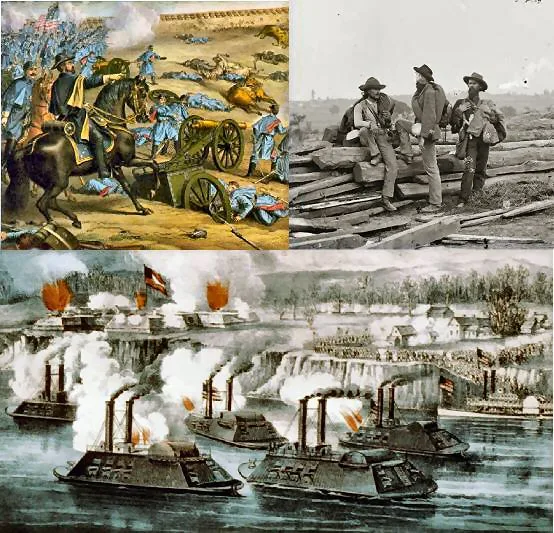
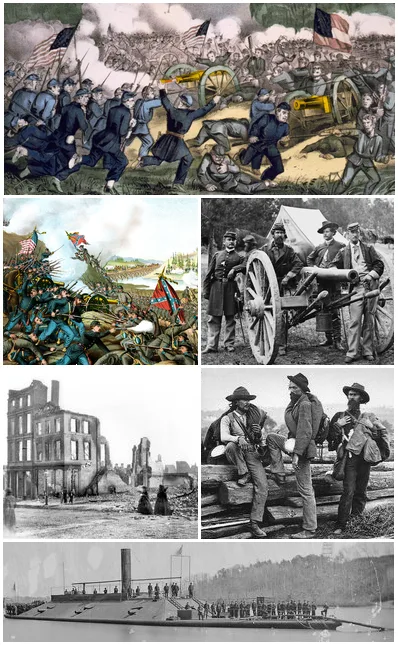
Overview
The American Civil War (1861–1865) was fought between the Union and a Confederacy formed explicitly to preserve slavery after Abraham Lincoln’s 1860 election, and it ended in Union victory, the dissolution of the Confederacy, and the legal freedom of four million enslaved African Americans — the single largest emancipation event in American history. The war began in April 1861 when Confederate forces bombarded Fort Sumter, and four years of intense combat followed, fought overwhelmingly on Southern soil, before the Confederacy’s defeat in the spring of 1865.
The Emancipation Proclamation
Ending slavery became an explicit Union war goal on January 1, 1863, when Lincoln issued the Emancipation Proclamation, declaring more than 3.5 million of the nation’s 4 million enslaved people in rebel-held territory legally free — a wartime measure that also formally opened the door for Black men to enlist in the Union Army and Navy. The Union’s military campaigns of 1862–1863, including the capture of New Orleans and the siege of Vicksburg, steadily extended the reach of that freedom deeper into Confederate territory as Union forces advanced.
The United States Colored Troops
African American soldiers organized into the United States Colored Troops (USCT) ultimately made up about one-tenth of the entire Union Army’s manpower across 175 regiments by war’s end, serving in infantry, artillery, and cavalry units, according to historian Kelly Mezurek. They fought and died at a disproportionate rate — roughly 20 percent of USCT soldiers were killed in action or died of disease, about 35 percent higher than the mortality rate among white Union troops — and 16 USCT soldiers received the Medal of Honor for their bravery. Frederick Douglass, recruiting Black soldiers in 1863, captured what their service meant: “Once let the black man get upon his person the brass letters U.S.; let him get an eagle on his button, and a musket on his shoulder, and bullets in his pocket, and there is no power on the earth or under the earth which can deny that he has earned the right of citizenship in the United States.”
Legacy
The war’s end brought full, nationwide abolition through the Thirteenth Amendment later in 1865, closing the chattel slavery system that had defined American life for more than two centuries and opening the Reconstruction era — detailed on its own page on this site — in which formerly enslaved Americans began building free lives, families, churches, schools, and, for a period, real political power. The Civil War stands as the pivotal turning point in African American history: the moment legal bondage ended nationwide, achieved through a combination of Union military victory and, critically, the direct, disproportionately costly participation of Black soldiers who fought for their own freedom rather than simply receiving it.
Related entries
More in Civil Rights, Military