Jim Crow era
American Beach
unincorporated community in Florida
Overview
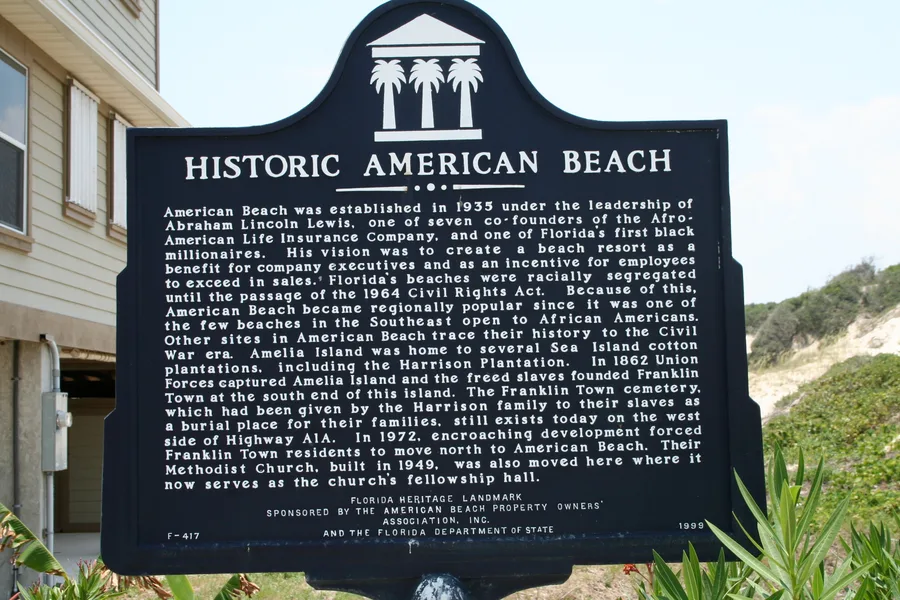
American Beach, on Florida’s Amelia Island north of Jacksonville, was founded in 1935 by Abraham Lincoln Lewis, Florida’s first Black millionaire, as a beach resort community built specifically for African Americans denied access to public beaches and pools under Jim Crow segregation. Lewis, a co-founder of the Afro-American Life Insurance Company in 1901, built his fortune filling a gap white-owned insurers refused to serve — insuring Black Americans that mainstream companies wouldn’t — and reinvested that wealth directly into community-building projects, including American Beach and the Lincoln Golf & Country Club.
“Recreation and Relaxation Without Humiliation”
Stretching across 216 acres, American Beach became, through the 1930s, 1940s, and 1950s, a thriving seasonal community of hotels, restaurants, nightclubs, homes, and businesses, summarized by its own guiding motto: “Recreation and Relaxation Without Humiliation” — a direct, deliberate answer to the daily indignities of segregated public space elsewhere in the state. Families, churches, and children filled the beach community every summer, building a self-sufficient Black leisure economy at a time when the wider Jim Crow South offered African Americans almost no comparable public recreational spaces.
Famous Visitors and the Beach Lady’s Fight to Preserve It
American Beach drew prominent Black entertainers and public figures including Joe Louis, Ossie Davis, and Sherman Hemsley — though even the beach’s own celebrated visitors were not immune to the era’s discrimination, as when James Brown was once turned away from performing outside Evans’ Rendezvous, a nightclub on the beach. After the 1964 Civil Rights Act desegregated Florida’s beaches, American Beach lost much of its original necessity as Black vacationers gained access to closer options, and 1964’s Hurricane Dora further damaged many of its homes and buildings. A. L. Lewis’s granddaughter, MaVynee Betsch — known locally as the “Beach Lady” — returned in 1977 specifically to fight for the community’s preservation, planting trees, leading historical tours, and campaigning against developers until her death in 2005.
Legacy
American Beach’s Historic District, roughly 40 acres containing 67 contributing buildings, was listed on the National Register of Historic Places on January 28, 2002, formally recognizing the community A. L. Lewis built as a place of national historical significance rather than a footnote to Florida’s broader tourism history. The A. L. Lewis Museum, a lifelong dream of Betsch’s, finally opened in 2014 to preserve and tell that history permanently. As one of relatively few surviving physical sites documenting Black-built leisure infrastructure under segregation, American Beach preserves a category of achievement this site treats as a priority: not only resistance to Jim Crow’s restrictions but the direct, entrepreneurial construction of full, dignified Black community life in spite of them.
Related
- Albany State University
- Bethune-Cookman University
- Central State University
- Coppin State University
- Delaware State University
- Dillard University
More in Business, Civil Rights