Contemporary
The Legacy Museum and National Memorial for Peace and Justice
National memorial in Montgomery, Alabama that commemorates the victims of lynching in the United States
This page describes a memorial to documented lynching victims and racial terrorism in the United States.
Overview
The National Memorial for Peace and Justice, informally called the National Lynching Memorial, opened in Montgomery, Alabama, on April 26, 2018, as the first memorial in the United States built specifically to commemorate the Black victims of lynching and to confront the nation’s history of racial terrorism directly. It was created by the nonprofit Equal Justice Initiative on a six-acre site, with the explicit goal, in EJI’s own words, of inspiring “communities across the nation to enter an era of truth-telling about racial injustice and their own local histories.”
805 Counties, Named and Counted
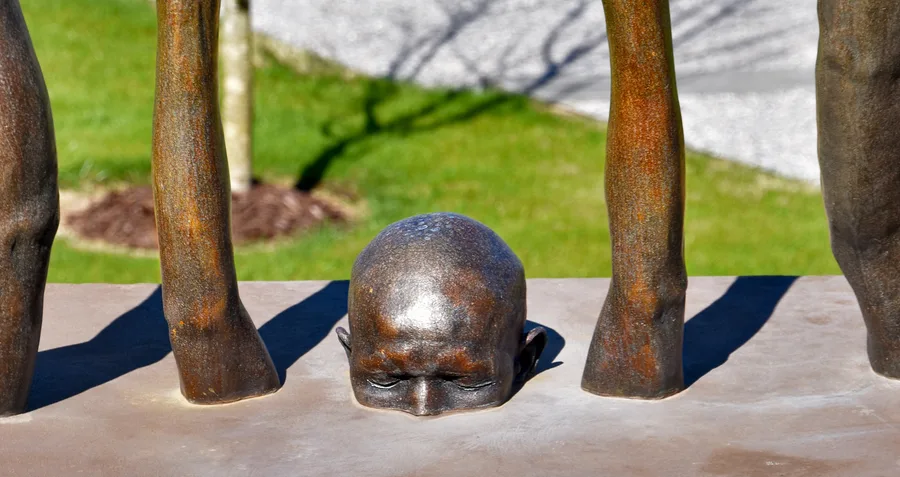
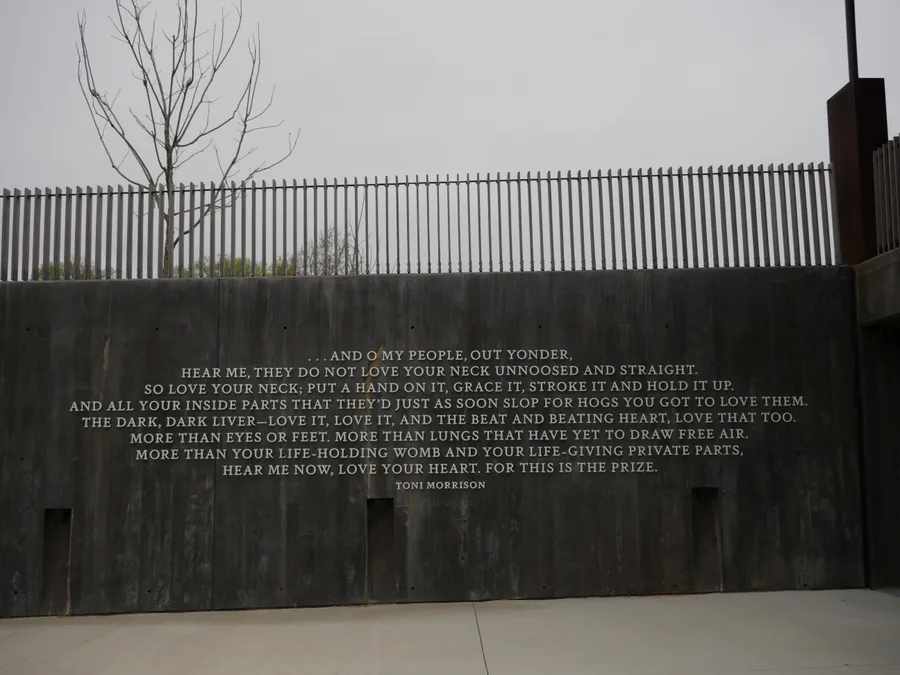
The memorial’s central feature is its memorial square, containing 805 hanging steel rectangles — one for each documented U.S. county where a lynching took place, each inscribed with the names of the victims killed there — a design that forces individual, county-by-county accountability rather than allowing this history to remain an abstract national statistic. The site also includes sculptures by artists Kwame Akoto-Bamfo, Dana King, and Hank Willis Thomas, writings from Toni Morrison, Elizabeth Alexander, and Martin Luther King Jr., and a dedicated reflection space honoring Ida B. Wells, the journalist and anti-lynching crusader profiled elsewhere on this site, whose own investigative reporting first documented the scale of this violence.
Nearly 4,400 Documented Lynchings
The memorial grew directly out of EJI’s multi-year investigation Lynching in America: Confronting the Legacy of Racial Terror, in which researchers combed county-level records across the United States and documented almost 4,400 racial terror lynchings between 1877 and 1950, concentrated most heavily in the decades surrounding the turn of the 20th century. EJI founder Bryan Stevenson has said he drew direct inspiration from Berlin’s Memorial to the Murdered Jews of Europe and Johannesburg’s Apartheid Museum in designing a single American memorial to the victims of white supremacist violence; the $20 million complex was built entirely with private foundation funding, and replica versions of its steel monuments are distributed to individual counties through EJI’s ongoing Community Remembrance Project.
Legacy
The memorial is directly connected to the adjacent Legacy Museum, which opened the same day near the site of a former market where enslaved people were once sold — deliberately linking the history of slavery to the racial terror lynching campaigns that followed it, and to contemporary issues of police violence the memorial also addresses. Critics have recognized the memorial’s power directly: The Washington Post’s Philip Kennicott called it “one of the most powerful and effective new memorials created in a generation,” and it stands today as the nation’s most direct, systematically documented public reckoning with the specific, named victims of racial terrorism.
Related
- Mae Jemison
- National Civil Rights Museum at the Lorraine Motel
- Negro Leagues Baseball Museum
- National Museum of African American History and Culture
- Texas Southern University
- National Underground Railroad Freedom Center
More in Civil Rights, Education