Colonial America / Early Republic
Benjamin Banneker
free African American scientist, surveyor, almanac author and farmer (1731–1806)
Overview
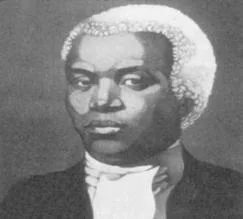
Benjamin Banneker, born in 1731 in Baltimore County, Maryland, to a free Black mother and a father who had formerly been enslaved, became one of early America’s most accomplished self-taught scientific minds — a naturalist, mathematician, astronomer, and almanac author who achieved national recognition despite having little to no formal education. Banneker’s astronomical calculations underpinned a commercially successful series of almanacs, technical publishing achievement for a Black American in the 18th century that stood as its own quiet rebuttal to contemporary claims of Black intellectual inferiority.
A Self-Built Wooden Clock
Around 1753, at about age 21, Banneker built a wooden clock that struck on the hour, reportedly working entirely from a borrowed pocket watch, carving each individual gear and part to scale by hand without ever having formally studied clockmaking — the clock kept working for the rest of his life. That same self-taught precision brought him into contact with the Ellicott family, Quaker millwrights who moved onto neighboring land near Banneker’s farm in 1772 to build the mills that grew into Ellicott’s Mills, Maryland, and who shared Banneker’s Quaker neighbors’ broader convictions on racial equality — a relationship that later opened the door to his most historically visible achievement.
Surveying the Nation’s Capital
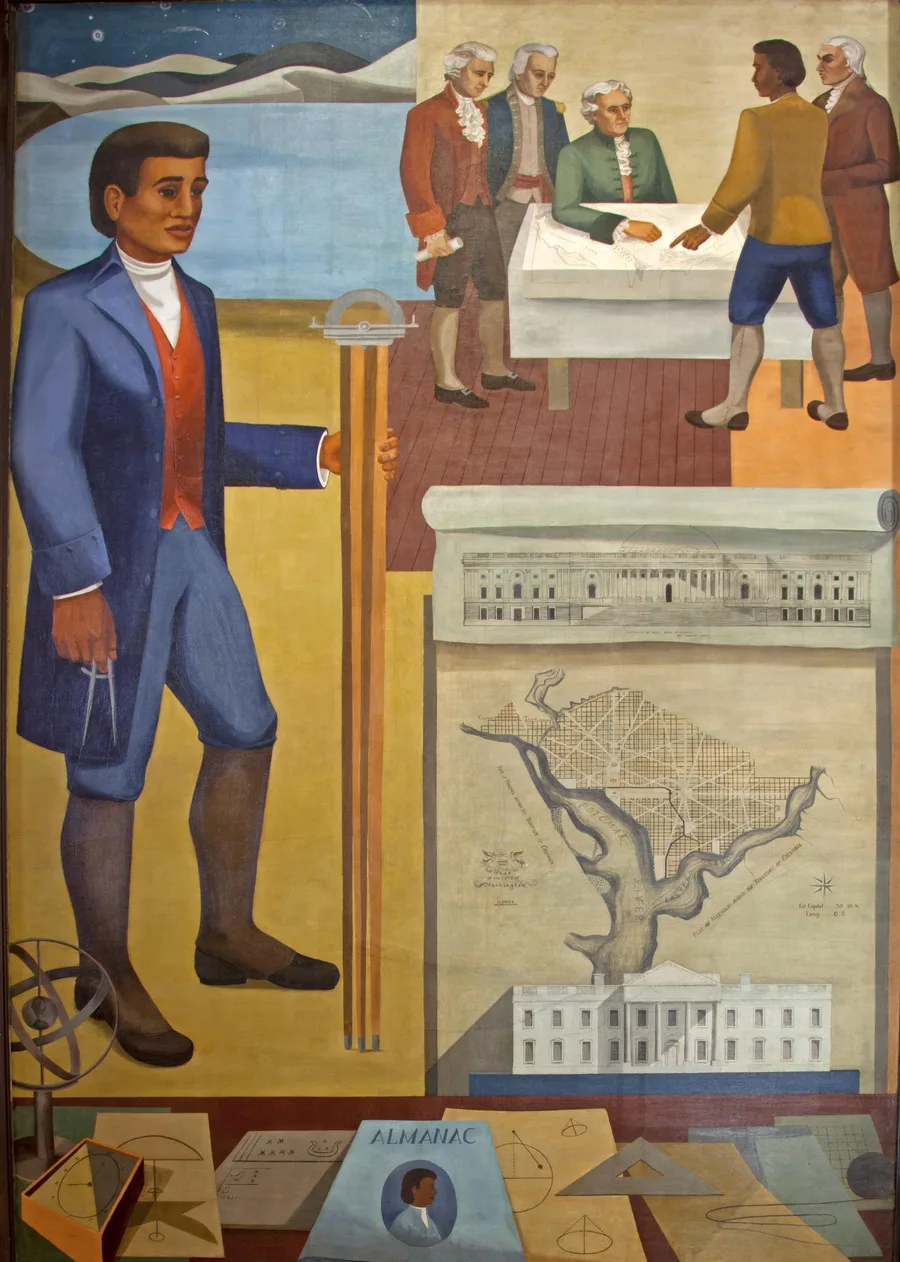
That achievement came when Banneker assisted Major Andrew Ellicott in the survey that established the original boundaries of the District of Columbia, the newly created federal capital of the United States — meaning a self-taught Black scientist helped lay out, with mathematical precision, the literal ground plan of the American seat of government. Banneker also directly corresponded with Thomas Jefferson on slavery and racial equality, using his own documented intellectual achievement as evidence against Jefferson’s published doubts about Black intellectual capacity, correspondence abolitionists and racial-equality advocates promoted widely both during Banneker’s life and after.
Legacy
A fire on the day of Banneker’s funeral destroyed much of his personal library and papers, though one of his journals and several artifacts survived, and in the decades after his death Banneker became something of a folk hero, with numerous accounts of his life exaggerated or embellished beyond the documented record — a pattern this site’s sourcing standards require noting explicitly rather than repeating uncritically. Parks, schools, and streets bearing Banneker’s name across the country today commemorate a man whose surveying and astronomical work put concrete, technical Black scientific achievement at the literal founding of the American capital.
Related
More in Literature, Science