c. 1600 CE – 1894 CE
Kingdom of Dahomey
1600–1904 kingdom in West Africa
Date range and summary are drafted from Wikidata pending a scholarly-source verification pass — treat as approximate, not settled fact, until re-sourced from academic historians/archaeologists.

Overview
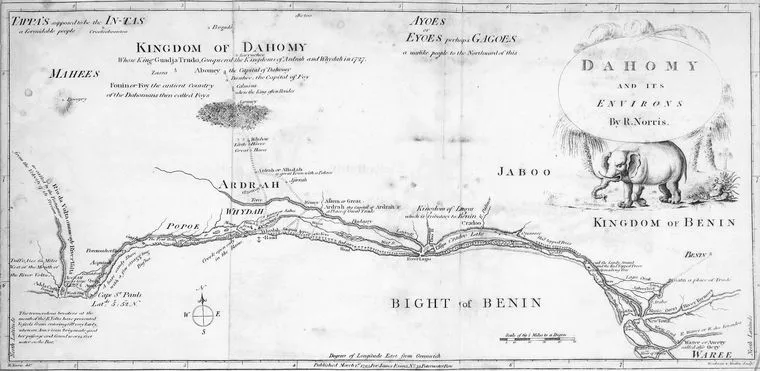
The Kingdom of Dahomey was a powerful West African state built by the Fon people on the Abomey Plateau, in what is now the Republic of Benin, existing from roughly 1600 until 1904. What began as a single kingdom among the Fon grew into a major regional power in the 18th century after conquering the coastal city of Whydah, giving Dahomey direct access to the Atlantic and ending its earlier tributary status to the powerful Oyo Empire to its east. By the 19th century, European visitors had documented Dahomey more extensively than almost any other African kingdom, making it one of the most internationally recognized African states of its era, known for a highly centralized government, a standing army, formal diplomacy with European powers, and a distinctive tradition of Vodun religious practice.
The Agojie: Dahomey’s Women Warriors
Dahomey’s most famous institution was its all-female military corps, known to European observers as the “Dahomey Amazons” and to the Fon as the Agojie. Elevated to prominence under King Ghezo in the 19th century, the Agojie were decisive in Dahomey’s military victories, including its defeat of the Oyo Empire that had once held Dahomey as a tributary state — a striking reversal of the regional power balance. Even European adversaries who fought Dahomey’s forces, and missionaries who worked in the kingdom, described Ghezo as an exceptionally capable and honorable ruler; the British missionary Thomas Birch Freeman called him “one of the most remarkable men of his age.” Ghezo also abolished the practice of human sacrifice of captives and ended the death penalty for lesser offenses, reforms carried out on his own initiative rather than through European pressure.
The Atlantic Trade and Its End
Dahomey’s growth was deeply tied to the Atlantic slave trade: it was a highly militarized state organized around warfare, and captives taken in war were sold to European traders in exchange for firearms, gunpowder, textiles, and other goods, while other captives labored on royal plantations. This economy came under sustained external pressure in the 1840s, as Britain’s Royal Navy West Africa Squadron enforced an anti-slave-trade blockade along the coast, forcing Dahomey to increasingly pivot toward the palm oil trade instead. Weakened further by military defeats at the hands of Abeokuta, a Yoruba city-state founded by Oyo refugees, Dahomey came into direct conflict with France in 1890 and was annexed into French West Africa by 1894 after King Béhanzin’s forces were overthrown.
Legacy
Dahomey’s traditional monarchy survives today as a constituent institution within the Republic of Benin — a country that took Dahomey’s name in 1975 as a deliberate act of honoring its pre-colonial heritage before adopting “Benin” instead, in recognition of the wider region’s history. Its kings no longer hold formal governing power under Benin’s constitution but continue to preside over major Vodun religious festivals and ceremonies that keep the kingdom’s spiritual traditions alive. The Agojie, meanwhile, have become one of the most widely recognized symbols of African women’s military leadership in the historical record, a legacy of documented, organized female combat command with few parallels anywhere in world history.