c. 100 CE – 1200 CE
Ghana Empire
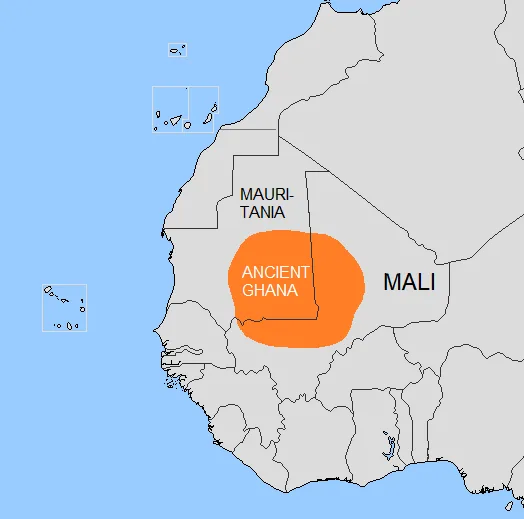
West African empire based in modern-day Mauritania and Mali (c. 200–c. 1200s)
Date range and summary are drafted from Wikidata pending a scholarly-source verification pass — treat as approximate, not settled fact, until re-sourced from academic historians/archaeologists.
Overview
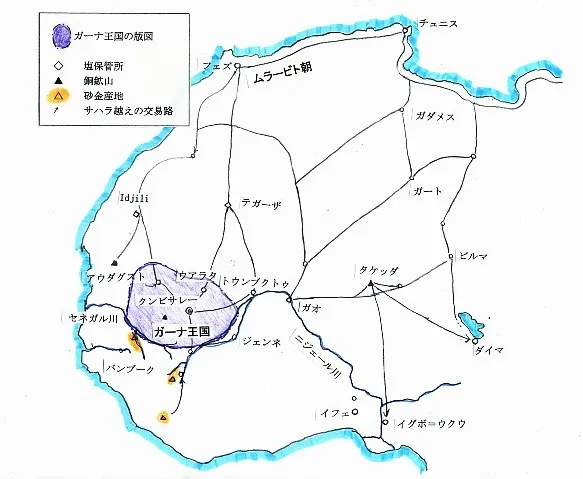
The Ghana Empire — known to its own Soninke people as Wagadu — was the first of the great trading empires of the West African Sahel, built in what is now southeastern Mauritania and western Mali. The earliest written record of its ruling dynasty comes from the Arab scholar al-Khwarizmi in 830 CE, and by the time the Cordoban scholar al-Bakri described the empire in the 11th century, Wagadu had already been a major regional power for generations, built on control of the trans-Saharan trade in gold and salt. The name “Ghana” itself was not the empire’s own name for its territory — it was the title given to the empire’s rulers, meaning “warrior” or “war chief.”
The Land of Gold
Wagadu’s kings held a second title, Kaya Maghan — “king of gold” — reflecting the source of the empire’s extraordinary wealth: control over the trade routes carrying West African gold north across the Sahara in exchange for salt, textiles, and other goods. Soninke oral tradition credits the empire’s founding to a legendary figure named Dinga and his son Dyabe, who established Wagadu after a defining encounter with a serpent deity, Bida, remembered in tradition as both a protective and demanding force tied to the empire’s prosperity. These oral traditions, alongside Arabic written accounts, together preserve a state whose administrative and commercial sophistication drew merchants and scholars from across North Africa.
Correcting a Colonial-Era Distortion
For most of the 20th century, some French colonial writers — most influentially Maurice Delafosse — argued that Wagadu’s rulers could not have been Black Africans and must have descended from Berber or Middle Eastern invaders, a theory built on strained readings of medieval Arabic genealogies. Modern scholarship has firmly rejected this. Every one of the earliest Arabic sources to describe Wagadu at first hand — including Ya’qubi in 872, al-Masudi around 944, and al-Bakri in 1068 — identifies its population and its rulers alike as Black Africans, and 20th-century archaeology at sites like Dhar Tichitt has traced Wagadu’s roots directly to local Soninke and proto-Mande agro-pastoral societies dating back to at least 1600 BCE, with no foreign founding dynasty required. Historians such as Charles Monteil sharply criticized Delafosse’s theory, and it survives today only as a case study in how colonial-era scholarship sometimes worked to deny African societies credit for their own achievements — exactly the kind of claim this site’s sourcing standards require checking against the evidence rather than repeating uncritically.
Decline and a Living Legacy
Wagadu’s centuries of prosperity gave way to decline in the early second millennium CE, and by the 13th century the empire had become a vassal state of the rising Mali Empire, which absorbed much of its former territory and inherited its role as master of the trans-Saharan gold trade. But Wagadu’s influence did not disappear with its political collapse — the urban centers it built shaped the region’s settlement pattern for centuries afterward. Its name outlived the empire itself by seven hundred years: in 1957, when the Gold Coast became the first sub-Saharan African colony to win independence, its leader Kwame Nkrumah chose to rename the new nation “Ghana,” a deliberate act of reclaiming a great pre-colonial African empire’s name and legacy for a modern African nation, even though the modern country lies well south of Wagadu’s own historical territory.